 Add to Chrome
 Add to Firefox
 Add to Edge
Training Long-Context Vision-Language Models Effectively with Generalization Beyond 128K Context
May 13, 2026
Long-context modeling is becoming a core capability of modern large vision-language models (LVLMs), enabling sustained context management across long-document understanding, video analysis, and multi-turn tool use in agentic workflows. Yet practical training recipes remain insufficiently explored, particularly for designing and balancing long-context data mixtures. In this work, we present a systematic study of long-context continued pre-training for LVLMs, extending a 7B model from 32K to 128K context with extensive ablations on long-document data. We first show that long-document VQA is substantially more effective than OCR transcription. Building on this observation, our ablations further yield three key findings: i) for sequence-length distribution, balanced data outperforms target-length-focused data (e.g., 128K), suggesting that long-context ability requires generalizable key-information retrieval across various lengths and positions; ii) retrieval remains the primary bottleneck, favoring retrieval-heavy mixtures with modest reasoning data for task diversity; and iii) pure long-document VQA largely preserves short-context capabilities, suggesting that instruction-formatted long data reduces the need for short-data mixing. Based on these findings, we introduce MMProLong, obtained by long-context continued pre-training from Qwen2.5-VL-7B with only a 5B-token budget. MMProLong improves long-document VQA scores by 7.1% and maintains strong performance at 256K and 512K contexts beyond its 128K training window, without additional training. It further generalizes to webpage-based multimodal needle retrieval, long-context vision-text compression, and long-video understanding without task-specific supervision. Overall, our study establishes a practical LongPT recipe and an empirical foundation for advancing long-context vision-language models.

PiLoT: Neural Pixel-to-3D Registration for UAV-based Ego and Target Geo-localization
Mar 21, 2026We present PiLoT, a unified framework that tackles UAV-based ego and target geo-localization. Conventional approaches rely on decoupled pipelines that fuse GNSS and Visual-Inertial Odometry (VIO) for ego-pose estimation, and active sensors like laser rangefinders for target localization. However, these methods are susceptible to failure in GNSS-denied environments and incur substantial hardware costs and complexity. PiLoT breaks this paradigm by directly registering live video stream against a geo-referenced 3D map. To achieve robust, accurate, and real-time performance, we introduce three key contributions: 1) a Dual-Thread Engine that decouples map rendering from core localization thread, ensuring both low latency while maintaining drift-free accuracy; 2) a large-scale synthetic dataset with precise geometric annotations (camera pose, depth maps). This dataset enables the training of a lightweight network that generalizes in a zero-shot manner from simulation to real data; and 3) a Joint Neural-Guided Stochastic-Gradient Optimizer (JNGO) that achieves robust convergence even under aggressive motion. Evaluations on a comprehensive set of public and newly collected benchmarks show that PiLoT outperforms state-of-the-art methods while running over 25 FPS on NVIDIA Jetson Orin platform. Our code and dataset is available at: https://github.com/Choyaa/PiLoT.
LoD-Loc v3: Generalized Aerial Localization in Dense Cities using Instance Silhouette Alignment
Mar 20, 2026We present LoD-Loc v3, a novel method for generalized aerial visual localization in dense urban environments. While prior work LoD-Loc v2 achieves localization through semantic building silhouette alignment with low-detail city models, it suffers from two key limitations: poor cross-scene generalization and frequent failure in dense building scenes. Our method addresses these challenges through two key innovations. First, we develop a new synthetic data generation pipeline that produces InsLoD-Loc - the largest instance segmentation dataset for aerial imagery to date, comprising 100k images with precise instance building annotations. This enables trained models to exhibit remarkable zero-shot generalization capability. Second, we reformulate the localization paradigm by shifting from semantic to instance silhouette alignment, which significantly reduces pose estimation ambiguity in dense scenes. Extensive experiments demonstrate that LoD-Loc v3 outperforms existing state-of-the-art (SOTA) baselines, achieving superior performance in both cross-scene and dense urban scenarios with a large margin. The project is available at https://nudt-sawlab.github.io/LoD-Locv3/.
The Llama 4 Herd: Architecture, Training, Evaluation, and Deployment Notes
Jan 15, 2026This document consolidates publicly reported technical details about Metas Llama 4 model family. It summarizes (i) released variants (Scout and Maverick) and the broader herd context including the previewed Behemoth teacher model, (ii) architectural characteristics beyond a high-level MoE description covering routed/shared-expert structure, early-fusion multimodality, and long-context design elements reported for Scout (iRoPE and length generalization strategies), (iii) training disclosures spanning pre-training, mid-training for long-context extension, and post-training methodology (lightweight SFT, online RL, and lightweight DPO) as described in release materials, (iv) developer-reported benchmark results for both base and instruction-tuned checkpoints, and (v) practical deployment constraints observed across major serving environments, including provider-specific context limits and quantization packaging. The manuscript also summarizes licensing obligations relevant to redistribution and derivative naming, and reviews publicly described safeguards and evaluation practices. The goal is to provide a compact technical reference for researchers and practitioners who need precise, source-backed facts about Llama 4.
Seedance 1.5 pro: A Native Audio-Visual Joint Generation Foundation Model
Dec 23, 2025Recent strides in video generation have paved the way for unified audio-visual generation. In this work, we present Seedance 1.5 pro, a foundational model engineered specifically for native, joint audio-video generation. Leveraging a dual-branch Diffusion Transformer architecture, the model integrates a cross-modal joint module with a specialized multi-stage data pipeline, achieving exceptional audio-visual synchronization and superior generation quality. To ensure practical utility, we implement meticulous post-training optimizations, including Supervised Fine-Tuning (SFT) on high-quality datasets and Reinforcement Learning from Human Feedback (RLHF) with multi-dimensional reward models. Furthermore, we introduce an acceleration framework that boosts inference speed by over 10X. Seedance 1.5 pro distinguishes itself through precise multilingual and dialect lip-syncing, dynamic cinematic camera control, and enhanced narrative coherence, positioning it as a robust engine for professional-grade content creation. Seedance 1.5 pro is now accessible on Volcano Engine at https://console.volcengine.com/ark/region:ark+cn-beijing/experience/vision?type=GenVideo.
SpatialTree: How Spatial Abilities Branch Out in MLLMs
Dec 23, 2025Cognitive science suggests that spatial ability develops progressively-from perception to reasoning and interaction. Yet in multimodal LLMs (MLLMs), this hierarchy remains poorly understood, as most studies focus on a narrow set of tasks. We introduce SpatialTree, a cognitive-science-inspired hierarchy that organizes spatial abilities into four levels: low-level perception (L1), mental mapping (L2), simulation (L3), and agentic competence (L4). Based on this taxonomy, we construct the first capability-centric hierarchical benchmark, thoroughly evaluating mainstream MLLMs across 27 sub-abilities. The evaluation results reveal a clear structure: L1 skills are largely orthogonal, whereas higher-level skills are strongly correlated, indicating increasing interdependency. Through targeted supervised fine-tuning, we uncover a surprising transfer dynamic-negative transfer within L1, but strong cross-level transfer from low- to high-level abilities with notable synergy. Finally, we explore how to improve the entire hierarchy. We find that naive RL that encourages extensive "thinking" is unreliable: it helps complex reasoning but hurts intuitive perception. We propose a simple auto-think strategy that suppresses unnecessary deliberation, enabling RL to consistently improve performance across all levels. By building SpatialTree, we provide a proof-of-concept framework for understanding and systematically scaling spatial abilities in MLLMs.
Virtual Width Networks
Nov 17, 2025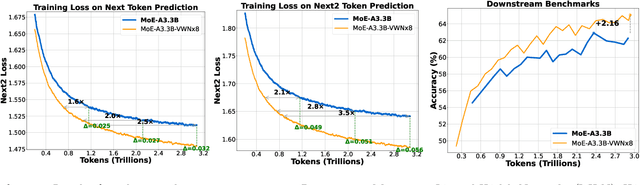
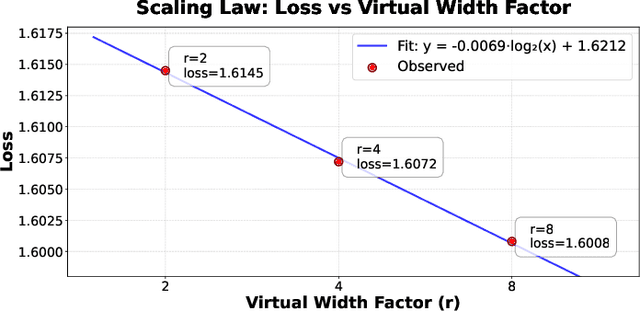
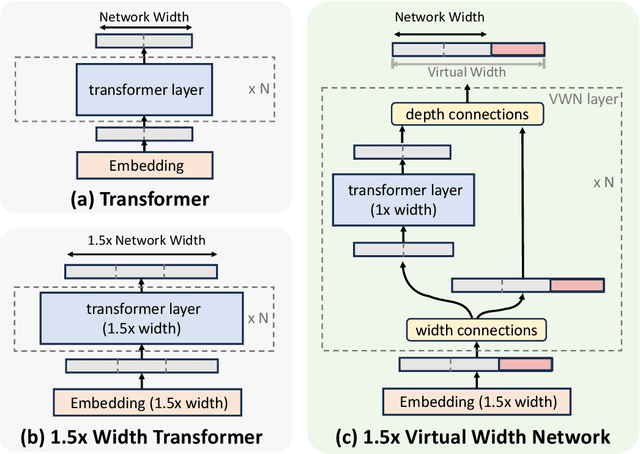
We introduce Virtual Width Networks (VWN), a framework that delivers the benefits of wider representations without incurring the quadratic cost of increasing the hidden size. VWN decouples representational width from backbone width, expanding the embedding space while keeping backbone compute nearly constant. In our large-scale experiment, an 8-times expansion accelerates optimization by over 2 times for next-token and 3 times for next-2-token prediction. The advantage amplifies over training as both the loss gap grows and the convergence-speedup ratio increases, showing that VWN is not only token-efficient but also increasingly effective with scale. Moreover, we identify an approximately log-linear scaling relation between virtual width and loss reduction, offering an initial empirical basis and motivation for exploring virtual-width scaling as a new dimension of large-model efficiency.
Visual Spatial Tuning
Nov 07, 2025Capturing spatial relationships from visual inputs is a cornerstone of human-like general intelligence. Several previous studies have tried to enhance the spatial awareness of Vision-Language Models (VLMs) by adding extra expert encoders, which brings extra overhead and usually harms general capabilities. To enhance the spatial ability in general architectures, we introduce Visual Spatial Tuning (VST), a comprehensive framework to cultivate VLMs with human-like visuospatial abilities, from spatial perception to reasoning. We first attempt to enhance spatial perception in VLMs by constructing a large-scale dataset termed VST-P, which comprises 4.1 million samples spanning 19 skills across single views, multiple images, and videos. Then, we present VST-R, a curated dataset with 135K samples that instruct models to reason in space. In particular, we adopt a progressive training pipeline: supervised fine-tuning to build foundational spatial knowledge, followed by reinforcement learning to further improve spatial reasoning abilities. Without the side-effect to general capabilities, the proposed VST consistently achieves state-of-the-art results on several spatial benchmarks, including $34.8\%$ on MMSI-Bench and $61.2\%$ on VSIBench. It turns out that the Vision-Language-Action models can be significantly enhanced with the proposed spatial tuning paradigm, paving the way for more physically grounded AI.
Generalizable Multispectral Land Cover Classification via Frequency-Aware Mixture of Low-Rank Token Experts
May 20, 2025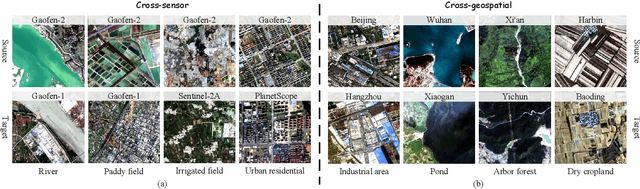
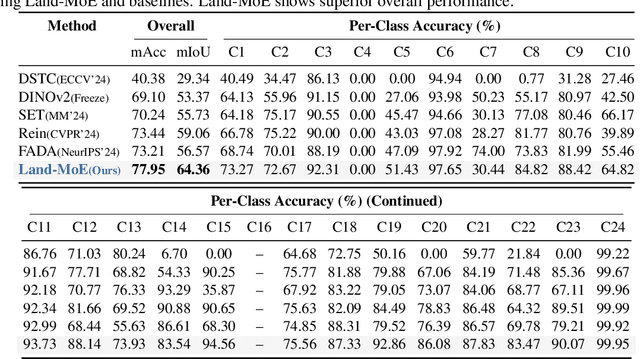
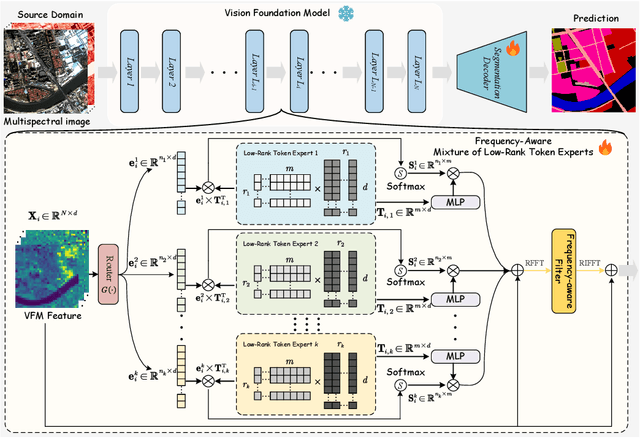
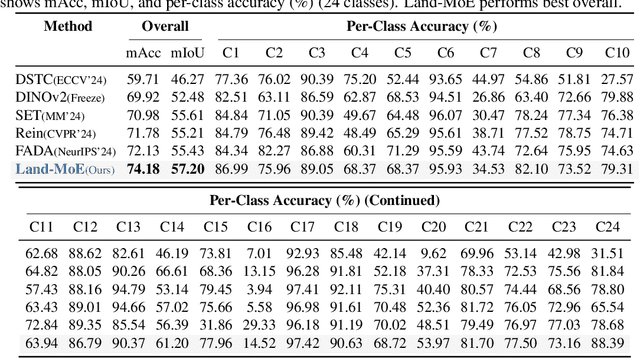
We introduce Land-MoE, a novel approach for multispectral land cover classification (MLCC). Spectral shift, which emerges from disparities in sensors and geospatial conditions, poses a significant challenge in this domain. Existing methods predominantly rely on domain adaptation and generalization strategies, often utilizing small-scale models that exhibit limited performance. In contrast, Land-MoE addresses these issues by hierarchically inserting a Frequency-aware Mixture of Low-rank Token Experts, to fine-tune Vision Foundation Models (VFMs) in a parameter-efficient manner. Specifically, Land-MoE comprises two key modules: the mixture of low-rank token experts (MoLTE) and frequency-aware filters (FAF). MoLTE leverages rank-differentiated tokens to generate diverse feature adjustments for individual instances within multispectral images. By dynamically combining learnable low-rank token experts of varying ranks, it enhances the robustness against spectral shifts. Meanwhile, FAF conducts frequency-domain modulation on the refined features. This process enables the model to effectively capture frequency band information that is strongly correlated with semantic essence, while simultaneously suppressing frequency noise irrelevant to the task. Comprehensive experiments on MLCC tasks involving cross-sensor and cross-geospatial setups demonstrate that Land-MoE outperforms existing methods by a large margin. Additionally, the proposed approach has also achieved state-of-the-art performance in domain generalization semantic segmentation tasks of RGB remote sensing images.
Model Merging in Pre-training of Large Language Models
May 17, 2025Model merging has emerged as a promising technique for enhancing large language models, though its application in large-scale pre-training remains relatively unexplored. In this paper, we present a comprehensive investigation of model merging techniques during the pre-training process. Through extensive experiments with both dense and Mixture-of-Experts (MoE) architectures ranging from millions to over 100 billion parameters, we demonstrate that merging checkpoints trained with constant learning rates not only achieves significant performance improvements but also enables accurate prediction of annealing behavior. These improvements lead to both more efficient model development and significantly lower training costs. Our detailed ablation studies on merging strategies and hyperparameters provide new insights into the underlying mechanisms while uncovering novel applications. Through comprehensive experimental analysis, we offer the open-source community practical pre-training guidelines for effective model merging.